
Sermon
A sermon for St. Paul’s Episcopal Church, Peoria, IL

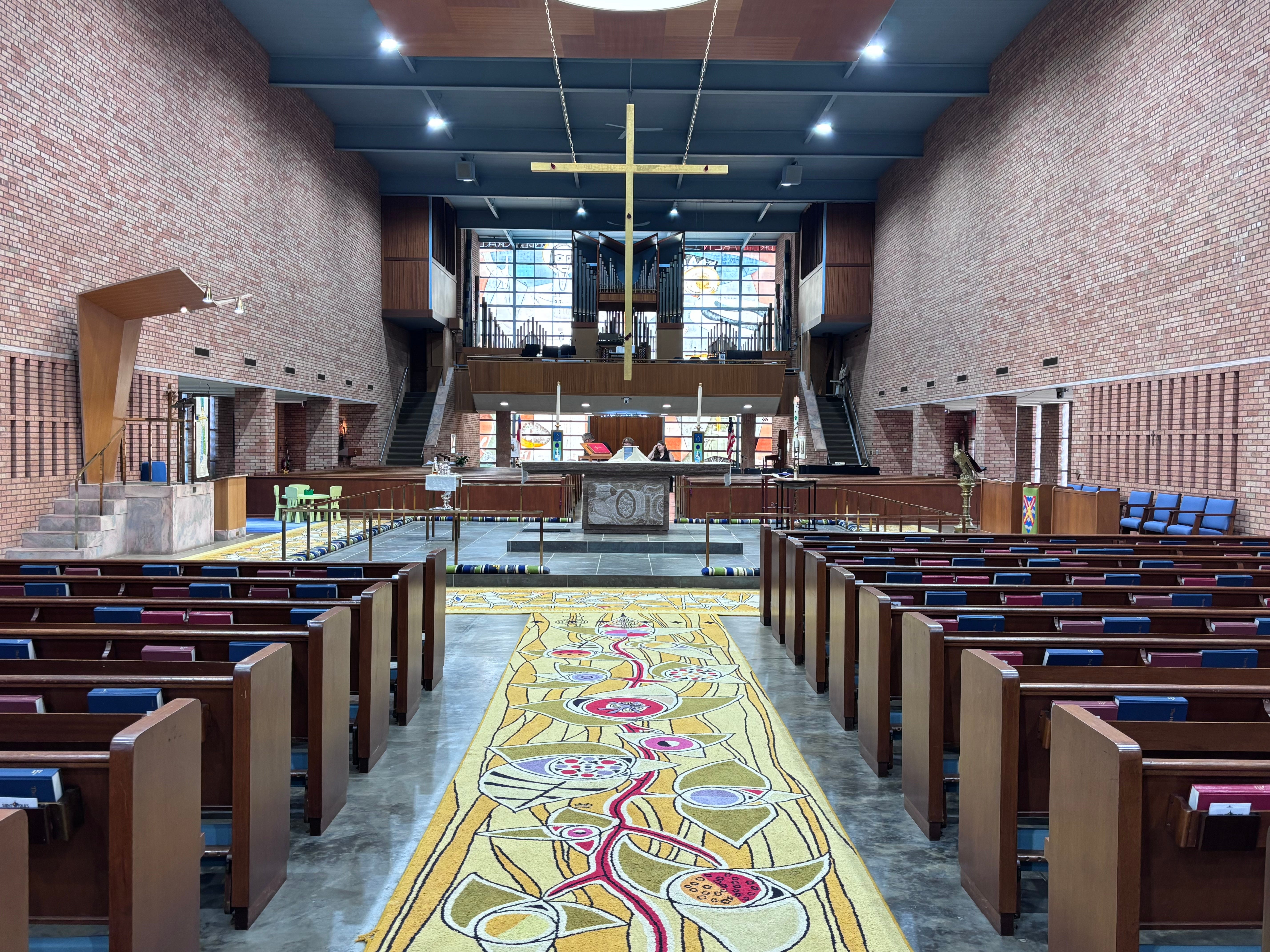
Hello and good morning. My name is Tripp Hudgins and I’ve been friends with Stephan Quarles for more than a decade. First, I want to thank you for the all the ways that you have rallied around my friends. Thank you for the care you have provided and the love shown. Friday’s service was a gift to all of us who love Holly.
Second, thank you, Stephan, for the invitation to preach this morning. It is always an honor when a friend who should know better asks you to offer a word.
As an introduction, I presently serve as the pastoral director of a monastery in Richmond, VA. Richmond Hill is a residential community and retreat center. We pray for the city of Richmond and for its healing three times a day. We develop programs to support the spiritual transformation of the people of Richmond. We address issues of race and class directly in these programs. Based in the Benedictine tradition, Richmond Hill is a place of healing and pilgrimage, for those seeking to repair the societal wounds created by the legacy of chattel slavery in Virginia.
You could say, I am 1/2 abbot and 1/2 Executive Director of a medium sized not for-profit.
We covet your prayers.
And it’s nice to meet you.
This morning’s sermon did not come easy. There is so much happening in our nation these days, that one can become overwhelmed and not know which way the Spirit is blowing. As always, the 24 hour news cycle is no help. Infotainment abounds. Social media, the algorithmic cul-de-saq and echo chamber is too loud, too insistent, too covetous of our attentions to actually serve us. We must serve it.
This morning’s sermon is about hope in the midst of all the noise. It is about Jesus’ promise of another way to walk through the world. His promises are forever true and good. For his yoke is easy and his burden is light.
Let us pray.
Lord, I believe. Help my unbelief. Make these words more than words and give us all the spirit of Jesus. Amen.
The subject of the separation of church and state has found its way into news headlines recently as Texas Lt. Governor Dan Patrick, who recently chaired President Trump’s Religious Liberty Commission, is leading an aggressive push to expand religious expression in public life and to eliminate the “separation of church and state.”
Now, this sermon will not be a lecture on the history of the separation. It will not be a recitation of any part of the US Constitution. But it is 4th of July weekend, so I do want to draw our attention to how religion is being utilized once again by political agents.
This is not a new thing. But that does not make it any less alarming, any less dangerous.
As I understand it, the separation of church and state is intended to protect minority religious movements within the United States from government interference.
During Thomas Jefferson’s time, this was the Baptists. In our time, we have other groups who are at risk.
The separation is intended to protect American citizens from oppression by the government based on their religious beliefs.
When this separation breaks down, there can be dire consequences. Oppression can come in the form of political favoritism, legislation limiting religious freedom, economic policies that make it harder for one group to support itself while another thrives, and more immediate consequences such as policing the freedom of speech, arrest, or imprisonment.
Government oppression of its own citizens becomes spiritualized, a form of religious expression itself, when one religious group is privileged above others. The harmful actions of the government are baptized by one group, given the authority of sanctity and thus legitimizing the abuse of power as the will of God against other groups.
It is not alarmist to say that this is where we are today. With the stated desire to eradicate the separation, even to claim that no such thing exists within the founding documents of the United States, the conditions for a Theocracy arise.
This is a political and religious calamity. Theocracies turn the power and presence of God into a weapon to justify the abuse of power by the state. State violence is baptized as religious service.
So what is the Christian to do? What is to be our relationship to the state? How do we uphold the separation and allow for religious liberty without bifurcating ourselves into the political us and the religious us?
For the political person is also the religious person and those competing claims of church and state rightly inform one another. Though the institutional power of church and state should remain separate, faith and politics cannot be.
Rejoice greatly, O daughter Zion!
Shout aloud, O daughter Jerusalem!
Lo, your king comes to you;
triumphant and victorious is he,
humble and riding on a donkey,
on a colt, the foal of a donkey.
We walk a tightrope.
Martin Luther King Jr., a Baptist interestingly enough, stated that Christians are called to be the “conscience of the state.”
Christians are not called to be the state. Christians are called to be the conscience of the state, to limit its power and violence through peaceful demonstration, prophetic calls for justice, and prayer. Without prayer to ground us, we will find ourselves rudderless and adrift.
What then is the work of the church in relation to the state?
Speaking truth to power is the work of the church.
This means we are called to speak a word of love to those with whom we disagree, those we dislike, misunderstand, or distrust. We are called to speak a word of love to those who might wish us harm.
Speaking truth to power is the work of the church.
The love of Christ is a scandal to all those who seek worldly power and influence to the detriment of the lost, the least, and the last.
Speaking truth to power is the work of the church.
For our Christ calls us to a life … even a political life … where our yoke is easy and our burden is light.
He will cut off the chariot from Ephraim
and the war horse from Jerusalem;
and the battle bow shall be cut off,
and he shall command peace to the nations;
his dominion shall be from sea to sea,
and from the River to the ends of the earth.
“My yoke is easy and my burden is light.”
I’ve often heard this quotation from scriptures in relation to emotional suffering. Situational suffering. Jesus will unburden us in some fashion. If we let go and let him carry our emotional load, then we will feel lighter somehow. Enlivened. I think this is true. I think Jesus does desire our healing and desires to carry our burdens for us.
And this promise of Jesus is to guide us in the life we create together as Church.
We are to live in the world in such a way that we release people from their burdens. We, the Church, who are the Body of Christ in the world, are to embody this promise that Jesus makes.
“My yoke is easy, and my burden is light.”
This pastoral word becomes a prophetic call to living in the world in such a way where hope not despair guides us.
It becomes a prophetic call to all who would follow Jesus to release people from their burdens. We can carry the emotional load. We have the resources to release people from the burdens of disenfranchisement, repressive systems of government, and the violence of the state.
“My yoke is easy, and my burden is light.”
We have hope. We have hope that Jesus’ promises are true. We have the hope that comes with the knowledge that God who is always merciful abides with us and walked among us as Jesus.
We have hope that Jesus walks among us now.
That he cares for the poor now.
That he heals the sick now.
That he gives sight to the blind now.
That he upholds the widow now.
That he cares for the orphan now.
That he brings peace now.
“My yoke is easy, and my burden is light.”
This is grace. And grace serves to heal us from our wounds. Like Jesus, we carry our wounds with us, but the resurrection life Jesus promises is a life where our wounds don’t define us. We walk with a lighter step when we walk with Jesus.
And we help create a world where others can walk lighter, too.
Friends of God, we carry our griefs together.
We carry one another.
Thanks be to God through Jesus Christ our Lord!
I was first lector last evening and felt honored to read the words because our world needs to read, take to heart the opportunity to proclaim these words from thousands of years ago.
Realized lately that I'd hidden too many pains from myself by dissociating, and a few joys. And the joys hurt more, which is weird, but kinda me if you know me. And re-connecting with all of that felt like a dam breaking and likely rearranged some relationships I thought were deeply set in my life.
In a way, some of these experiences made me think of Paul's epistle this morning, the infamous "I do the thing I don't want to do." I think I was dissociating because I was afraid of my selfishness, my wants, somewhat in line with how I was raised. And in that way I was carrying my own sins in a way that wasn't healthy. By holding them a certain way, I was hiding them from my own awareness, but also making my life a lot heavier. The weird thing was that outing myself in a certain sense made everything lighter. I really feel more honest now. And it is, I think, the right way to be in the long run. Even if I'm cracked, at least I can try to bridge the cracks and draw myself back together. That's healing. I can also deal with the screwed up bits of myself because I can look at them honestly.
Maybe politics is the same. A stranger on bsky was talking about hating people for having the wrong POV's, and I could understand that, even empathize, but I didn't think it was helpful. I can't hate people. I have to work with them, though I don't actively seek them out. And they are not my cross to bear, nor my yoke.