
Let’s Get Down To It
TL/DR: This is a nuts and bolts post about what it means to be an urban monastery praying for the spirit of the city.

I want to back up a bit. I’ve been writing about the monastery and the monastic without defining my terms. I’m a recovering academic and sometimes I forget that I prefer to start with the theoretical or with insider language. Never hesitate to call me out on that. So, this morning, I want to play with a line we often use here at Richmond Hill to begin to make sense of what we’re actually doing. I hope this serves.
“Richmond Hill is an urban monastery praying for the spirit of the city…”
What does this phrase mean to me? Let’s break it down.
Richmond Hill…that’s us. Founded in the mid-1980’s, the goal of the organization was to continue the ministry of praying for the city of Richmond that the Sisters of The Visitation of Monte Maria practiced for more than a century. Founded in 1865, the Sisters took the ministry of prayer for the city seriously. And in the fallout of the American Civil War, there was much to pray about. They lived their vocation to pray for the city and supported themselves through various other means for 120 years. They even made bread for the Eucharist for various Catholic parishes in the diocese. Eventually, the building became too difficult to manage and they had outgrown the space. The nuns moved out to Hanover Co. and the property was put up for sale.
The not-for-profit, Richmond Hill, Inc. was formed through the collective efforts of various religious leaders in Richmond, many of whom were Civil Rights Era leaders, in response to the departure of the Sisters. These leaders understood the call to pray for the city as a call to specifically pray for the racial healing of the metropolitan city. As you might imagine, Richmond’s history and present is fraught with the emotional and spiritual pain that the legacy of slavery creates. Again, there is much to pray about. Continuing the work that the Sisters began was on all their hearts and minds.
The incorporated entity quickly became a community which gathered regularly to pray for the racial healing of the metropolitan city. Their firm belief was that prayer can change people and changed people can transform a city. Quickly, a residential community formed. By 1990, there was a small group of committed people praying three times a day for Richmond and the healing required from the legacy of slavery in the chapel at Richmond Hill.
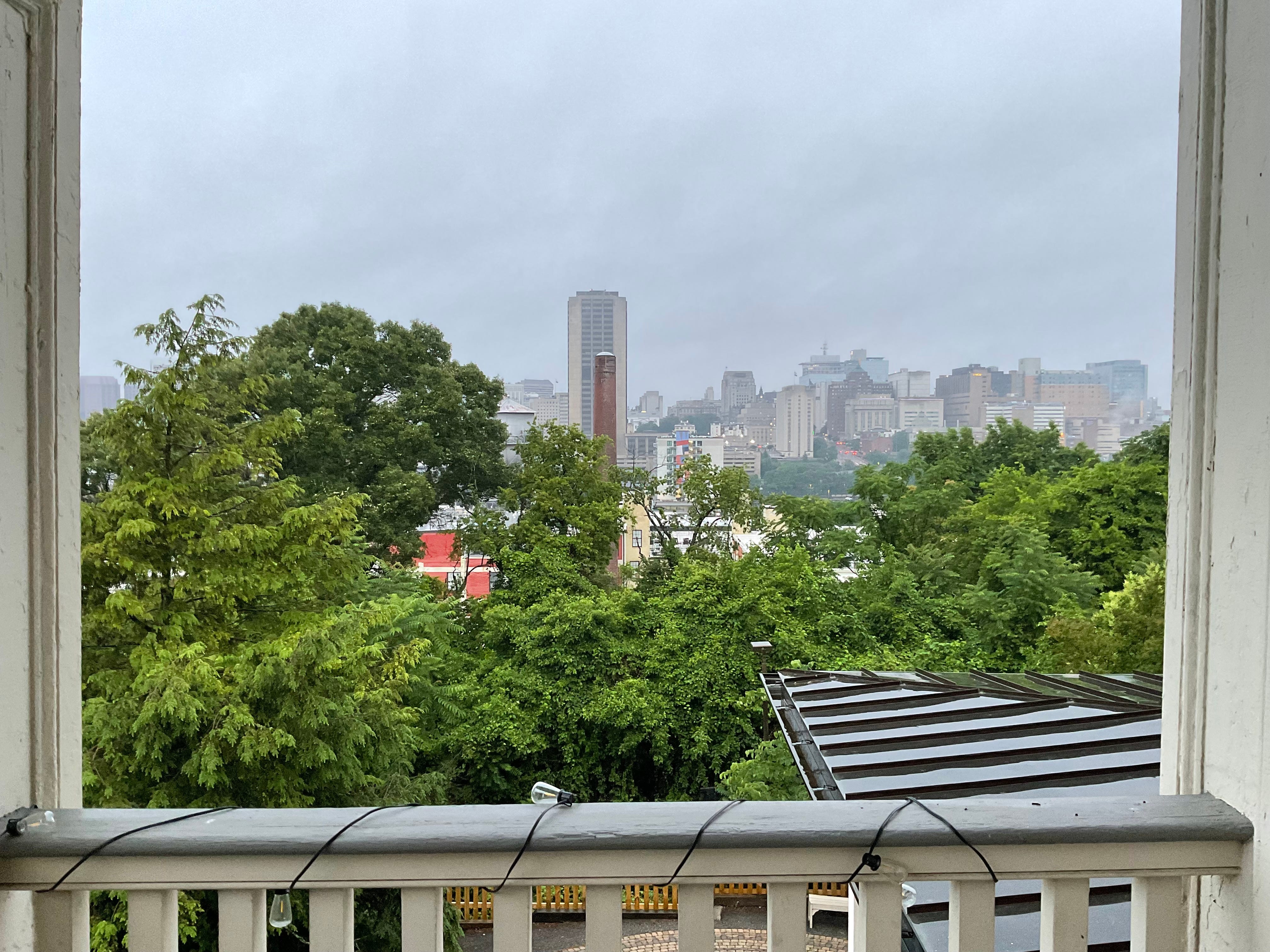
Enter the “urban monastery.” As fate or providence would have it, the old monastery is located in Church Hill. From our vantage point, we can see downtown and even the Governor’s Mansion. With its tall buildings and historic architecture, it’s a compelling vista. There is even a popular scenic look out at the edge of the hill on Grace Street. From that vantage point, you see not just the skyline, but Shockoe Valley and the locations of the slave market, Lumpkin’s jail, and other sites that remember the slave trade for us.
Our location is decidedly urban. An “urban monastery” is both a place and a people committed to living in the midst of the struggles of the modern metropolitan city. It is not a place apart, but a place of solidarity and shared struggle within the wider Richmond community. The monastery serves as a place where God’s presence can be welcomed and shared. For the residents, this is embodied in the ministry of hospitality. We welcome people to pray with us and to stay here either as individuals or as groups who may wish to go on a retreat. The guest house has 42 beds and we have multiple meeting rooms for programs.
Not insignificant, when Richmond Hill was founded, Church Hill was considered a blighted community. It was a food desert and the location of much crime and violence. You may recall that Richmond itself was one of the murder capitals of the nation in the 1980s and 1990s peaking in 1997. There were, of course, racial dynamics to all of this. Thanks to red lining (see: the systematic demolition of the Jackson Ward neighborhood) and white flight to the surrounding counties, the city’s tax base had been gutted, leaving for the most part the poorer communities to fend for themselves. The “crack cocaine epidemic” was often blamed for the violence in the city. Again, racism played a large role in terms of reality and perception. The difficulties Richmond faced were deemed “black issues” as white people fled both the city and abdicated their responsibilities to their neighbors.
There was much to pray for and other work to be done in the city to help heal it.
We are a monastery in part because that was the original use of the building and in part because we are also a residential community that keeps a rhythm of prayer and a Rule of Life based on the Benedictine Rule. The monastery is both the building and the people who live here.
In the year 2026, much of Church Hill has gentrified. There is a grocery store right down the hill. There are coffee shops that are walking distance from the monastery. This does not mean that violence no longer visits us here. But the dynamic has changed considerably. Homes directly across the street from Richmond Hill are selling for a million dollars. But just down the hill from us in Shockoe Valley, the neighborhood is struggling with gun violence and crime. Again, all of this pain and struggle can be tied back to the reality of racism in Richmond. The neighborhood may have changed, but the legacy of slavery impacts us still as black communities are forced out of homes and neighborhoods families have lived in for generations.
Now, I imagine you can begin to understand what “praying for the spirit of the city” might mean. The city is a living organism, a collective of individuals, of communities, and of ecologies. It has a spirit, a soul, and it needs tending and healing. Thankfully, we are not alone in that work, but the work is still essential for the city’s survival and transformation.
We are a community committed to the transformation of the metropolitan city. We gather at 7:00, noon, and 5:30 to pray for the city. This is our primary vocation. Everything else we do is an extension of this work. From the rewilding the monastery garden, our school for spiritual direction, and our youth mentoring program, we are working toward the healing of the city. But it all begins with prayer. Prayer is our shared vocation.
I hope this helps make some sense of what we’re about. So when I wax theological and spiritual about what it means to me to be here, you’ll have some context. I’ll still write about the spiritual underpinnings and our practices. Have no fear! I just wanted to write about the nuts and bolts of it all.
Thank you. I was a part of the residential community from 2003 to 2012 and I saw my life there reflected in your words.
Thank you so much for this, Tripp. This "nuts and bolts" really gave me a better understanding of the origins of Richmond Hill and its present daily life. I was very moved by it. Although I'm still in California, I have family in Fluvanna County, about an hour's drive from Richmond. If I get to Virginia for a visit (unfortunately, not able to do so this year), I would be interested in visiting Richmond Hill for an individual retreat.