There are so many jokes.

Too many.

About how congregations make the associate pastor or the seminary intern preach on Trinity Sunday. These are often funny jokes. Everyone laughs. And the teaching pastor dodges a theological bullet because…is three a magic number or not?

Will you pray with me?

Lord, I believe.
Help my unbelief.
Make these words more than words.
	And give us all the
		Spirit of Jesus.
			Amen.

Now, technically, it is not Trinity Sunday. That was two days ago. And, technically, not every Christian tradition holds to the particular lectionary calendar that marks a special day for a Fourth Century Doctrine.

I know. You’re shocked.

But I like to imagine I occupy a decreasingly peculiar space both personally and vocationally. We embody ecumenism here at Richmond Hill. And my catechetical upbringing was ecumenical to the core. I became a Christian in the university classroom, the choir loft, and in this chapel.

I have shared this before, but I wasn’t raised in church. I read Frazer’s The Golden Bough and Bullfinch’s Mythology before I ever studied the Bible. It has always been the wide sweep of humanity’s religious and spiritual practices and beliefs that interest me. I want to know who we are and why we choose to believe in something so undefinable as God in the first place.

It was in classroom, in music, and in prayer that those questions finally began to find something like an answer.

The oldest known temple…temple, not practice or spiritual tradition…practice would certainly predate any human construction…the oldest known temple is Göbekli Tepe. It is 12,000 years old…which makes it more than 6,000 years older than Stonehenge. Humanity has been ritualizing, liturgizing, spiritualizing, and dare I say theologizing for a very long time.

Who is God?
Who are we?
Does any of this matter?
Should we light a fire and talk about it?

Sure! I’ll bring my bone flute. It’s only 50,000 years old. Maybe we can sing a chorus or two.

It’s been a long road. And on a cosmological scale, humanity is barely getting started. So, what’s the big deal about a doctrine?And, perhaps more importantly, one that claims three is one and one is three and monotheism is polytheistic? Why would we celebrate what so many would rather avoid in the first place?

What are we even doing, people?

Well…maybe we’re up to these three things. They are synonyms of a sort, but the shades of nuance matter…

We are trying to make meaning from experience.
We are trying to make reason from abstraction.
We are trying to make sense of who we are.

I. We are trying to make meaning…

Meaning doesn’t just happen on its own. It has to be made. It is situated in cultures large and small simultaneously. Meaning making is self-making both individually and collectively. This is why meaning making can be so contentious. A single symbol can represent multiple meanings simultaneously…even meanings conflicting with one another.

The Great Commission is a useful example. What does this verse mean? Does it mean that we have to compel everyone we encounter get their doctrinal ducks in a row? Or does it mean something different like a gentle invitation to come swimming in the waters of faith with new friends.

Now, you might think that I am making one meaning stand over the other. And I am. But that’s more a sign of my cultural and social location than it is anything intrinsic in the passage itself. I don’t possess a monopoly on scriptural interpretation. Again, we make meaning. Then, somewhere in the give and take of meaning making, the symbol begins to make us.

We experience the Holy Invitation to share something we love with others.
	Maybe we experience God’s call in hearing that passage.
		Maybe we’re puzzled by the scholarly consensus that suggests that the passage is a later addition to the scriptures. The original Matthew did not include this verse.

			Maybe it’s some combination of all three. Meaning is almost never singular.

	Meaning is a mash-up of tunes and beats all happening at once.

 II. We are trying to make reason…

	I get it. Your brain is clouded from all the thinking you do every day. I get it. Trust me. Mine hasn’t worked well for years. One day the service engine light comes on your mental dashboard and never turns of. Never. But this is not that. We are trying to make meaning out of abstraction.

 	We are met with abstraction after abstraction in our spiritual lives. Akin to experience, there is some encounter and we’re trying to reason out what we encountered. Was it God? Was it something we ate? We reason with one another. Maybe, we argue. We disagree. Maybe we come to consensus.

	We share an encounter with the divine and now we want to understand that encounter and its implications. At Richmond Hill, we call this discernment in the midst of community. We make reason from abstraction. From this collective and individual work, we believe we discover echoes of the will of God in our own lives.

III. We are trying to make sense…

…Of who we are. Of our place in creation. Of the God who set it all spinning in an inconceivable explosion of Grace and Love and will gather it all back in a cosmic embrace. What difference does experience or encounter with a God make in who we are? Does it matter?

This is why we worship. We gather with one another and worship in part to discover who we are and who we are becoming. Not in a sociological sense, but in a theological sense. Empowered by the Holy Spirit, we constitute the Body of Christ Jesus on this earth in this moment. We worship because worship remembers this when life is so hard or simply distracting that we forget. We make sense together.

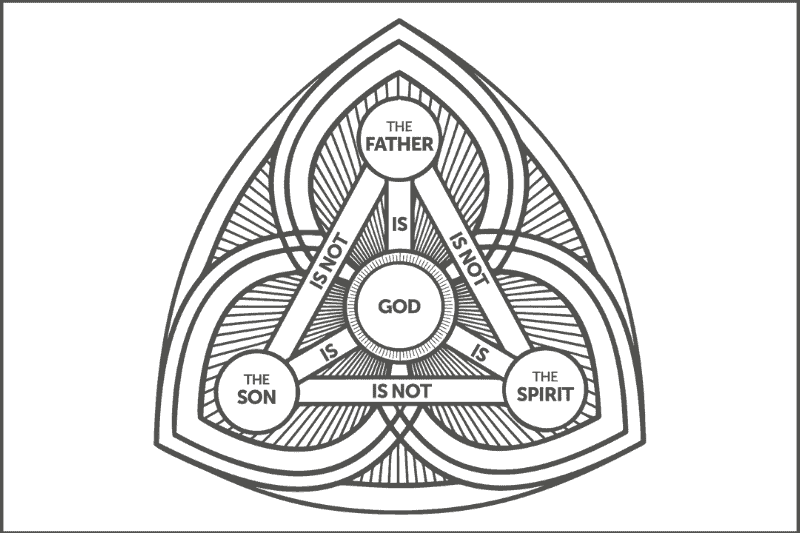
These nuanced movements are at the core of Trinitarian Theology. The Holy Trinity is an opportunity to express meaning, reason, and sense as we stand before God together in wonder and awe.

I told you all of that so I could tell you this.

For the Christian, the doctrine of the Holy Trinity is the spiritual scaffolding we need to be set free from false ideologies that would entrap us and isolate us from one another.

The Trinity is inherently relational. When we encounter God, we encounter the beautiful, the good, and the true in relationship with one another and a single Deity simultaneously. To say the least, we need a robust symbol to help us navigate the vastness that is God. The Trinity is that symbol. Bold. Complex. Demanding.

The Doctrine of The Holy Trinity is a doctrine ideally suited for our time.

Calling us to relationship, to discernment, and to wonder…Trinitarian theology becomes revolutionary.

Trinitarian Theology becomes a theology of resistance. Trinitarian Theology becomes the foundation of the constant reform needed in the Church. From this place of constant reform, the Church becomes the leaven in the loaf of human society. We show society a better way by living the way of Jesus, the Second Person of The Trinity.

Trinitarian theology liberates because it calls all of us to change, to enter the dance that is the divine. And in that change, we are unified.

Hear that.

We are unified in change. Amen.


You are still my favorite writer on Substack. After reading your words, I have nothing to say. Keep channeling the Holy Spirit.
Now, this is just what I needed to hear this morning. Thank you for sharing! Now I understand better why and how I am so drawn to the Trinity!